Is this how we treat our Female Soldiers? Families seek answers about daughters' "Non-Combat" deaths

U.S. Army Sgt. Christopher McBeth has endured two tours in Iraq, where he regularly engaged in combat hell. The 28-year-old has served for 10 years, but during summer 2010, war finally got him and his family. The military told him his younger sister, U.S. Army Spc. Morganne McBeth, had suffered a noncombat related death in Iraq and they weren't at liberty to explain exactly how she died.
All military families deserve closure after their loved ones’ deaths in Afghanistan and Iraq, and the McBeths are still waiting eight months after the tragedy.
“They haven’t told me anything,” said McBeth, fighting his emotions. “I have no clue what happened to her.”
The military has not offered a definitive explanation as to what happened to 19-year-old Morganne, who lived to jump out of C-130 Hercules aircraft.
While leaving McBeth completely out of the loop, the military has attempted during the last several months to explain Morganne’s death to her parents, Sylvia and Leonard McBeth, of Fredericksburg, Va.
Initially, the military told Morganne’s parents she accidentally stabbed herself and that it might have been a suicide. Her parents didn’t buy it and reached out to Rep. Rob Wittman (R-Va.). Pressure from Wittman apparently convinced the military to offer some kind of information because soon after his involvement, the military told them Morganne’s death was likely a murder.
Two male soldiers from her unit have been charged and are free while the investigation continues. Spc. Nicholas Bailey, 23, was charged with involuntary manslaughter and conspiring to obstruct justice by giving a false statement. Spc. Tyler Cain, 21, was charged with conspiring to obstruct justice.
The story of the McBeth family and its need for closure is not an isolated experience. There are scores of military families who want clear answers about what happened to their daughters and sons in Afghanistan and Iraq. One of the most publicized stories is that of icon Pat Tillman, whose death some believe the Department of Defense tried to cover up to glorify the U.S. military as it aggressively continues to seek new volunteer troops in the post-9/11 world.
For just women, there are at least 20 families who believe the military isn’t telling the truth about how their daughters died in Afghanistan and Iraq, according to retired Army Col. Ann Wright, who served in Somali during the early 1990s and quit her State Department job in 2003 in protest of the Iraq invasion.
More than 130 U.S. military women have died in Afghanistan and Iraq, and the Department of Defense has deemed nearly 50 deaths noncombat related. Wright said at least 20 of the noncombat deaths are suspicious, and their families are speaking out to some degree.
Out of the 20 female soldier deaths under scrutiny, military reports document 14 as suicides. Many of their families refuse to accept the military’s explanation and believe their daughters died at the hands of others, possibly fellow soldiers.
This much is clear: The mysterious deaths of female soldiers coincide with an increase in reported sexual violence against women in the military.
Because of this, these families question whether their daughters’ suicides were actually rapes and murders. If so, then military investigators either bungled their investigations or are orchestrating cover-ups during wartime, when the Department of Defense is more dependent on female soldiers than ever before.
Since 2002, most enlisted U.S. military men that have committed suicide have done so in the U.S., perhaps in the aftermath of exposure to combat. But for enlisted women soldiers, they’re more likely to commit suicide overseas and on base, especially within Afghanistan and Iraq, Wright said.
“The question of why women would be more likely to commit suicide outside the U.S. than once home should be investigated,” she wrote in an article for StopMilitaryRape.org.
Here are several stories of female soldiers who the military said committed suicide or were victims of noncombat deaths, and their families and friends are refusing to accept the military’s explanations:
Army Spc. Seteria Brown,22, of Orlando, Fla. Friends said everybody loved the outgoing and positive Brown, who left behind a 6-year-old daughter. The military said while stationed in Afghanistan in 2008, she put her M16 barrel to her heart and pulled the trigger.
Army Pvt. Tina Priest, 20, of Smithville, Texas. Her mom said she was shy and “a follower.” She wanted to be a medic, but several weeks into her 2006 deployment to Iraq, she called home saying she had been raped and that “no one was going to believe her.” Just a few days after telling her mother, the military said Priest put her M16 barrel to her heart and pulled the trigger with her toe.
Army Staff Sgt. Amy Tirador, 29, of Albany, N.Y. The military said while Tirador was on perimeter guard duty in Iraq in 2009, she shot herself in the back of the head. A former unit mate, Army veteran Gena Smith said: “Amy was a remarkable soldier and inspiring leader. Her family is insisting that they will do whatever it takes to prove she didn’t kill herself.”
Marine Lance Cpl. Stacy Dryden, 22, of Canton, Ohio. The military said Dryden did not kill herself but was found deceased in a portable latrine in Iraq in 2008. Historically, female soldiers have referred to the on-base Porta-Potties as “rape traps.” What is significant about Dryden’s case is that her death, according to military investigators, was due to injuries suffered during a “friendly wrestling match” she had with a U.S. Navy sailor who body-slammed her onto concrete. The sailor has not been charged with any crime. Dryden’s family pressed for clearer answers, and in January 2011, military investigators changed their explanation and said the wrestling match was actually a hostile confrontation after the sailor made a derogatory remark to Dryden.
Is this how we treat our female soldiers?
Similar to the McBeths, the family of Pvt. Lavena Johnson could not get a straight story out of Army investigators on their daughter’s 2005 death in Iraq. Her death has come under intense media scrutiny. Johnson has become the face of noncombat female death and has been championed by Mary Tillman, mother of Pat Tillman.
The Department of Defense’s first official version claimed that Johnson, a violin player and honor student, killed herself by putting the barrel of an M16 in her mouth as the tent she was in burned around her. She ended it all, in a fiery rage, said investigators from the Army’s Criminal Investigation Division, or C.I.D, because a new boyfriend of two months dumped her in an e-mail from Kentucky.
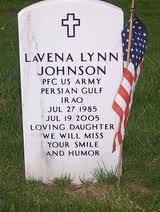
In 2009, C.I.D. changed answers in a written statement to Republican Rep. Sue Myrick of North Carolina. C.I.D. stated Johnson never set fire to the tent, even though eyewitnesses first on the scene testified that parts of the tent were in flames.
According to military documents, Johnson’s commanding officer, James Woods, told investigators that before her suicide, she was always smiling and that he did not see any changes in behavior.
The Senate Armed Services Committee eventually signed off on C.I.D.’s investigation. Case closed.
The story of Lavena Johnson, however, is far from over. Five years have passed since her death, and Lavena's father, John Johnson of St. Louis, Mo., is still battling the military. He said he has one simple reason for this: The evidence that his daughter didn't take her life but instead was raped and murdered is too great to ignore.
The military's official autopsy revealed a busted lip, broken teeth and scratch marks on Lavena’s neck. Two ballistics experts, Donald Marion and Cyril Wecht, also told the family that Lavena’s wounds were not consistent with an M16 and that the alleged exit wound from the top of her head looks more like an entry wound caused by a 9 mm pistol.
Her father and friends also paid to disinter her body for a second autopsy, and new X-rays revealed a broken neck. The second autopsy showed that the military had removed part of Lavena's tongue, vagina and anus and didn't tell the Johnsons about this or document the removals in the first autopsy.
As implausible as it sounds, the taking of body parts such as the heart or brain without notifying the family has happened to several other female soldiers whose deaths were ruled noncombat related.
Ed Buice from the Naval Criminal Investigative Services, or NCIS, said, “Since (these female soldiers) were adults, no parental permission would have been required, and organs are generally placed back into the body cavity and [the] torso is sewn up.”
John Johnson believes the missing body parts were taken to cover up a sexual assault.
"My daughter wanted to serve her country, and they're going to insult her like this?" he asked angrily. "The Army had the absolute chutzpah to say she killed herself. We believe she was raped and murdered by a contractor. If they had a daughter [that died in a war zone], they would be acting the same way; there's no doubt. And I'm not resting until something is done."
What the U.S. military says about Lavena, Morganne and others
Chris Grey, chief of public affairs for the C.I.D., the lead investigating body on Lavena’s case, said his heart goes out to John Johnson.
“Some families have a very difficult time believing a loved one would do this,” he said. “Other journalists have been turned off by the very complete and thorough criminal investigation we underwent.”
The case remains closed, but Grey asked that anyone with new leads in Lavena’s case to come forward. If the information is legitimate, her investigation will be reopened.
John Johnson has pushed Grey for answers, and his tenacity has not gone unrewarded. His efforts have helped expose a disturbing part of the U.S. military — what some people refer to as military sexual trauma, or MST.
Johnson said he believes the Department of Defense is fully aware of MST and trying desperately the keep the problem off the public radar because recruiting young women, who are increasingly joining the military, will suffer.
In 1970, women accounted for 1.4 percent of all military personnel, according to military documents. Today, that number is 20 percent, or 300,000 women. When troop levels in the Iraq war zone theatre were at their highest, there were four times more women in theatre than during the 1991 Gulf War.
More women are also being ordered into combat. According to a January 2011 CNN article, the Military Leadership Diversity Commission called for a gradual end on the ban on women in combat, even though the ban was seemingly already in effect.
Since 9/11, women soldiers have garnered two Silver Stars. And before 9/11, one Silver Star had been awarded to a female. According to a March 2010 New York Times article, Marine “female engagement teams” that are heavily armed and in full gear are on patrol in the Afghan countryside to win over Afghan women.
Even though the military’s need for women soldiers is apparent, “There is a pattern of violence against women soldiers, especially in Iraq,” said an anonymous Congressional staffer who spent hundreds of hours investigating the Johnson case.
Army veteran Tiffany Jones-Wright, who’s been championing the awareness of one of the 20 deaths of female soldiers under suspicion, said on many bases in Afghanistan and Iraq, men outnumber women probably 30 to 1.
“It could be a civilian contractor or the military,” she said. “The men on base are crazy. They keep coming at you, coming at you. It’s like you’re new meat to them. Sometimes they approach me with my husband right there.”
Jones-Wright said she is sick of the way women are being mistreated by the military. She’s also passionate about Brown, her former unit mate, who the military said put the barrel of her M16 to her heart and ended it all on base in Sharana, Afghanistan, in 2008.
“Even if you met her the first time, (you would know) she wasn’t capable of this,” Jones-Wright said. “She was a happy person. They way she talked about her daughter … she would never do this because of her daughter. Never!”
The MST numbers: present and unknown
MST, which encompasses both assault and harassment, and also includes male victims, is no dark secret and in no way a new trend for the military.
Two decades have passed since Tailhook, where Navy aviators forced female officers to run a gauntlet where they were groped. A seminal moment in bringing attention to MST occurred in 2003, when the American Journal of Industrialized Medicine published a study in which it interviewed roughly 500 female veterans who were enlisted sometime between Vietnam and the first Iraq war. According to the study, one in three stated she experienced “one or more completed or attempted rapes.”
In 2006, Congress mandated the Department of Defense to initiate a comprehensive program to track sexual assaults. MST victims said it’s stunning to consider the department took until the 21st century to begin totaling sexual assaults annually within all five military branches and oversea commands.
In fiscal year 2008, 2,900 sexual assaults were reported. This was a nine-percent increase across the armed forces and a 26-percent increase in war zones from 2007. For fiscal year 2009, there were 3,230 reports of sexual assault, an 11-percent increase across the armed forces from 2008 and a 33-percent increase in war zones.
These figures do not include the troop members and veterans who were scared to come forward. The Department of Defense has estimated the number of unreported sexual assaults in the armed forces is between 50 and 80 percent.
Seeking to reveal MST statistics the Department of Defense refuses to make public, the American Civil Liberties Union and the Service Women’s Action Network filed a lawsuit against the Department of Defense and the Department Veterans Affairs in December. The groups said the Department of Defense needs to release the number of convictions, acquittals and sexual-harassment complaints to expose the entire MST problem.
Predators know they can get away with it
What is painfully unmistakable is that the U.S. military has a culture where rape victims are re-victimized when they try to report crimes to commanding officers, Wright said.
“Most times the perp is good friends with the platoon sergeant or commanding officer, and they tell the victim, ‘You’re nothing but a private, and you want to ruin the career of this guy who wants to make the military his life?’” Wright said. “They tell the private, ‘Just shut up.’ This type of intimidation is so prevalent.”
According to military law, commanding officers have the final decision on whether military personnel of their unit are charged with a criminal offense that occurred while on duty. In a war zone, the air of intimidation, according to Wright, can be ratcheted to another level simply because the victim is surrounded by violence and confusion.
“They’ll say, ‘You’re going to be dead by tomorrow,’” Wright said. “‘Raping you is just the cost of war. We’ll just chalk it up (your murder) to unsafe security.’”
Wright said the foremost reason why some male soldiers are so brazen about rape and sexual harassment is simply because the military tolerates it, even while Secretary of Defense Robert Gates insists the military doesn’t stand for any type of MST.
According to 2007 Department of Denfense statistics, 600 out of roughly 2,200 sexual-assault cases investigated had suspects facing any sort of accountability.
One hundred eighty of the 600 suspects were court-martialed, meaning they would face trial by a military court. This means just under 10 percent of military sexual-assault suspects faced prosecution that year; in the civilian world, 40 percent on average face prosecution per year.
Nonpunitive administrative action or discharge was recommended for 220 of the 600 suspects, and the final 200 suspects were given nonjudicial punishment. Nonjudicial punishment is essentially a slap on the wrist and involves being subjected to extra work duties, for instance.
The other 1,600 sexual-assault cases for 2007 were dropped.
Coincidently, a 2008 Government Accountability Office survey found 50 percent of military sexual-assault victims never even reported the crime because they felt nothing would come of it.
“This matter is a laughing stock among men in the military,” Wright said. “It’s like a joke for the guys because they know they’ll never get prosecuted. The atmosphere in the military is you know you can get away with it.”
What was their non-action truly worth?
To gauge just how seriously the Department of Defense takes MST, victim advocates said they consider how the department ran its 12-member Defense Task Force on Sexual Assault in the Military.
In 2005, Congress mandated the Department of Defense to form this task force to develop prevention strategies and track data. But in 2008, the Government Accountability Office, or GAO, discovered the task force hadn’t done anything substantial regarding MST (PDF).
The 12 task force members spent $15 million over three years and told the GAO they needed the millions to pay civilian staff and cover travel expenses.
What was the task force’s non-action truly worth? Wright said nearly 6,000 military rapes occurred during those three years.
To the Department of Defense’s credit, another task force at the time — the Department of Defense Task Force Report for Victims of Sexual Assault — realized the department needed a lead office to establish and enforce sexual-assault policy matters across the armed services.
In 2005, the Department of Defense created the Sexual Assault Prevention and Response Office, or SAPRO, which strictly deals with sexual assault and harassment, and its accomplishments are gaining traction.
SAPRO established a 24-hour global hotline, a number given to all soldiers during their pre-deployment training. According to a January 2011 article in The Christian Science Monitor, the Army is also training 4,000 victim advocates and sexual-assault response coordinators, or SARCs, and the Navy has trained an estimated 12,000 healthcare personnel for sexual-assault response.
Additionally, the Department of Defense created the Sexual Harassment/Assault Responsive Program, or SHARP, a grassroots effort for all military personnel, which has produced a rap song titled “I.A.M. STRONG.” The song’s chorus includes: “You need to … Intervene! Motivate! Act! … Turnin’ the other cheek is a thing of the past!”
The rap mirrors SAPRO’s fundamental prevention for sexual assault and harassment against the female soldier — bystander’s intervention.
Karen Whitley, SAPRO director, said just as society has learned to take the keys away from an imminent drunk driver, the Department of Defense urges military personnel to intervene in situation they believe might result in MST.
Whitley said inspiring major shifts in cultural attitudes, such as the effort to raise awareness about the dangers of drunk driving over the last 30 years, takes eight to 10 years before witnessing any lasting success.
“We’re now five years into this,” she said. “I feel the military leads the way on improving societal issues, and I feel we’re going to make a difference here.”
But not long after its creation, SAPRO became a target of MST advocates. They argue some of SAPRO’s newly implemented policies to help encourage more victims to report MST crimes — such as restricted reporting — are not tough enough and even laughable.
Restricted and unrestricted reporting
Army veteran Susan Avila-Smith runs the MST advocacy group VETWOW, which stands for Veteran Women Organizing Women.
Avila-Smith’s been advocating for MST victims since 1995, after the military refused to punish her Army ex-husband after he jumped up and down on her pregnant stomach and killed their baby. Yet what enraged her to become an MST advocate was what happened after she sought justice from commanding officers.
“I was told not to talk to anybody about it or I would be BCD’d, which is a Bad Conduct Discharge,” she said.
Avila-Smith said VETWOW represents 3,000 veterans who were raped during their enlistment, and nearly all of them told their commanding officers about the crime. Many revealed to her the fallout from this was worse than the rape itself, she said.
Before the military put into action new sexual-assault reporting procedures in 2005, military law offered rape victims only a single choice if they were to seek an investigation. Tell company-level commanding officers about the rape and who the alleged rapist was. Company-level commanders oversee between 75 to 200 troops and are judge and jury when handing down criminal charges that occur while on duty.
Thus it's no surprise some Department of Defense sexual-assault task forces of this decade have made the issue of confidentiality for rape victims a top priority. This is a clear signal that the re-victimization of rape victims in the military is arguably the greatest obstacle to derailing MST.
Seeking confidentiality, SAPRO initiated a two-track sexual-assault reporting policy in 2005 called restricted and unrestricted reporting.
Restricted reporting allows the victim a new choice — to bypass chain of command by not having to disclose the name of the victim or the rapist.
Instead, restricted reporting permits a victim to call a SARC on a hotline or tell a victim advocate such as a chaplain or healthcare professional. Once a restricted report is made, advocacy and counseling is initiated for the victim, but an investigation is not triggered.
Unrestricted reporting sticks with military tradition. Service members who desire an investigation, along with healthcare services, must notify commanding officers of the rape and whom they’re accusing.
For the 3,500 soldiers who have utilized restricted reporting, Whitley called it “remarkable progress.”
“That’s 3,500 people we feel we’re helping who would have never come forward if not for restricted reporting,” she said. “And that tells me it’s working.”
But there are several glaring drawbacks to restricted reporting, Avila-Smith said, and the limitations are also posted on SHARP’s website.
According to the SHARP website, “Your assailant remains unpunished and capable of assaulting other victims,” and “You will continue to have contact with your assailant, if he/she is in your organization billeted with you.”
Essentially, an alleged rapist goes free under restricted reporting, and if the alleged rapist is in the same unit as the victim, which is a common occurrence according to VETWOW, the predator is still interacting with the victim.
“We’ve struggled with this, but what we want is people to come forward and get the care they need,” Avila-Smith said.
VETWOW and other MST advocacy groups refuse to acknowledge restricted reporting as a remedy to curb MST. Simply put, restricted reporting has meant 3,500 alleged predators got away with rape, she said.
“Restricted reporting? It’s a joke,” Avila-Smith said with a scoff. According to her, the number one thing the Department of Defense needs to do is hold commanding officers accountable — meaning higher-ranked commanders or civilians trained in prosecuting sexual assault are allowed transparency to the MST investigations of commanding officers and an equal or greater say when administering an indictment.
Other MST advocates are also championing institutional overhauls. U.S. Army veteran Olga Ferrer is the director of A Black Rose, a nonprofit MST advocacy group. While stationed in Kuwait during the Gulf War, Ferrer was alone in a shared shower facility when a male soldier snuck up from behind.
She filed a report and sought military police to help with the investigation, but instead they told her the “report had vanished.” She is adamant the only way to end MST is to involve a civilian element.
“Every military site — overseas or in the U.S. — should have a unit or group, that includes doctors, nurses, therapists, that investigates sexual assaults and does not fall under the DOD or military,” she said. “These people will be the ones where all sexual assaults will be reported to.”
She said restricted reporting makes her anger boil.
“The alleged rapist should immediately be removed from the victim’s unit, and the victim should also be placed somewhere else,” Ferrer said. “They should not be working together. Period. The only one being restricted is the victim.”
“Just tell the truth”
Avila-Smith believes civilians can remain patriotic and supportive of the troops but need to see the U.S. military and its culture with objective eyes.
“People don’t want to care because people don’t want to believe this is true,” she said. “And because it doesn’t exist to them, they have no empathy for victims.”
In regards to Lavena Johnson, Avila-Smith said, “It’s really truly amazing what the military will do to cover things up.”
“It would be so much better if the military just tells the truth,” she said. “It would be quicker, cleaner and a whole lot cheaper. Just tell the truth.”
Spot.us note: Susan Burke, a highly regarded Washington D.C.-based attorney is preparing to file a class-action lawsuit on behalf of MST survivors to change how the U.S. military deals with sexual-assault committed within its ranks as well as its aftermath. The suit will ask for both damages and changes in the military’s practices so that everyone who wants to serve our country can do so free from sexual harassment and assault. Burke can be contacted at ssajadi AT burkeoneil DOT com.
The following poem was written by “greensthings-2009” in the comments section of Katie Couric’s article “Sexual Assault Permeates U.S. Armed Forces.”
1979.
18 years old.
The Army.
Germany, sent out to the field for the first time.
The only woman and 1500 men.
I was the Medic, they were Engineers.
Alone, in the dark being watched, only I didn't know
Vilseck, Germany after two weeks without a shower, we were allowed to go to Tent city for 2 days.
Much Celebrating. Much Drinking. After showers the partying started.
I was invited.
A cute boy
Fun
free drinks
more drinks
Something wrong....
Room spinning
Dizzy
can't walk
being carried
pass out
wake up
can't move
tied up
can't talk
gag in mouth
voices
someone on me
wet between the legs
laughter
another body on me
tears
another body
all night
over and over again
how many?
Don't know
too many
over and over again
thrusting
sweaty
pawing
pain
tearing
more laughter
in and out of conscience
how many?
could be twenty
could be a hundred
all ranks
all sizes
all ages
all *******
all thrusting
all sweating
lots of pain
smell of greasy tent
smell of booze
smell of tobacco
smell of man sweat
smell of *****
smell of sex
all thrusting
all groping
all squeezing
all pawing
only one, who when he saw my tears, stopped in his tracks
But he walked out, and another came in to take his place
over and over again
no help
none in sight
all night long
in and out of reality
in and out of dreams
more body's
more men
more thrusting
how many hours?
finally the sweet release of awareness
awakening
naked
in the showers
bruises and blood everywhere
Pain
oh my God the pain
all consuming pain
my clothing in a pile
scrub
scrub
scrub
scrub
scrub
scrub
scrub
scrub
water is cold
scrub some more
scrub
scrub
scrub
scrub
scrub
scrub
scrub
scrub
put on uniform
met at door, by commanding Officer
stern words about MY behavior
told if I talked, it would be MY fault
Threatened with prison for "enticing"
handed orders to be transfered
Told to pack my bags
Transportation waiting
Warned again
If you talk, you die
or worse
watching blindly as the trees roll by
curling up inside of me
hiding the pain
hoping the pain will fade
as the bruises do
can't walk, can't sit, can't take a ****
blaming myself
Others have
so why not me?
Guilt
it weighs on a mind
remembering what was said
silence it is my friend
denial
lock the pain away
never talk they said
never talk I did
The pain it became my friend
To this day, it never ends.
~~~~~~~~~~~~~~~~~~~~~~~~~~~~~~~~~~~~~~~~~~~~~~~~
This is the first time I have EVER written or spoken about that night. The ONLY reason I have after thirty years is, because it is STILL going on! What happened to me, happens to thousands of women in the military ever year!----------
This article was reprinted in its entirety with the permission of the author.


